
VACUUM PHASE-CHANGE
≥90% thermal efficiency. No overheating risk. Lower fuel cost than conventional fire tube heaters -- field-deployable in a split-body modular design.

Where Higher Efficiency Justifies the Step Up from a Water Bath Heater
Water bath heaters are proven field equipment. But when heating duty is large, when fuel gas is expensive or limited, or when 24/7 continuous operation means fuel costs compound over years -- vacuum phase-change heaters deliver a measurably lower cost of operation. The efficiency gap between 80% and 90% sounds modest; at 1,000 kW of heating duty running 8,000 hours per year, it is a significant volume of fuel gas saved annually.

High-Duty Continuous Heating at Gathering Stations
Gathering stations processing production from multiple wells operate their heaters around the clock, across seasons. Thermal efficiency directly determines annual fuel consumption -- and in remote locations, every cubic meter of fuel gas has a real cost or opportunity cost. At heating duties above 500 kW, the operational cost savings accumulate to a meaningful figure over a 3-5 year operating cycle.

High Pour-Point Crude Oil Heating
High pour-point crude requires sustained, reliable heating to remain pumpable. The phase-change heat transfer mechanism delivers heat to the process coil with exceptional uniformity -- no hot spots, no localized overheating. For crude oils that are sensitive to thermal degradation or wax precipitation from over-temperature, this uniformity is a process quality advantage.

Remote Wellsites Requiring Rapid Deployment
The split-body modular design allows the unit to be broken into transportable sections that fit standard road transport dimensions and can be assembled on-site without heavy lifting equipment. For remote wellsites where access limits vehicle dimensions, or where schedules demand fast time-to-heat, the split-body design is a major logistical advantage.

Natural Gas Heating Before Processing
Natural gas heating upstream of molecular sieve dehydration, NGL recovery, or gas compression requires precise temperature control. The inherent temperature-limiting characteristic of vacuum phase-change heating provides a natural safeguard against gas overheating that protects sensitive downstream equipment and adsorbent beds.
Operating Principle: Phase-Change Heat Transfer Under Vacuum

Why Vacuum Changes Everything
The fundamental limitation of a conventional water bath heater is that it transfers heat by sensible heating of the bath water. A vacuum phase-change heater operates on a fundamentally different principle: the heat transfer medium is water that is intentionally maintained under vacuum inside a sealed shell. At 0.05 MPa absolute pressure, the boiling point is approximately 81°C.
Latent Heat vs. Sensible Heat
Steam rises from the pool and contacts the process coils in the condensing zone. It condenses on the cooler surfaces, releasing its latent heat of vaporization (approx. 2,260 kJ/kg) directly to the process fluid in a continuous thermosiphon cycle requiring no mechanical circulation. This is why thermal efficiency exceeds 90%.
Inherent Temperature Limiting
The vacuum boiling point acts as a self-regulating temperature ceiling. Regardless of burner firing rate, the heat medium temperature cannot exceed the vacuum boiling point without generating more steam than can condense. There is no mechanism by which the process coil can be exposed to a runaway temperature excursion.
Longer Equipment Life
Because phase-change heat transfer is so efficient, the process fluid achieves its required outlet temperature with a heat medium at 80-90°C. Lower heat medium temperature means lower thermal stress on the coil material, lower corrosion rates, and longer service life for all wetted components.
Split-Body Modular Design
LINSON OIL's vacuum phase-change heaters are designed with a split body: the firebox section and the process coil section are separate modules connected on-site. This design allows independent transport within standard road dimensions and facilitates field assembly without heavy lifting equipment.
Engineering Specifications
Detailed technical parameters for standard vacuum phase-change heater units.

| Parameter | Standard Range | Notes |
|---|---|---|
| Heating Duty | 100 kW - 5,000 kW | Multiple units in parallel for larger duties |
| Thermal Efficiency | ≥ 90% | At design operating conditions; verified in factory test |
| Process Media | Crude oil / Natural gas / Water | High-viscosity or heavy crude: consult LINSON OIL |
| Process Outlet Temperature | Up to 80°C | Limited by vacuum boiling point (self-regulating) |
| Heat Medium | Demineralized water under vacuum | Sealed system; no make-up required under normal operation |
| Vacuum Operating Pressure | 0.04 - 0.08 MPa (absolute) | Corresponds to boiling point 76°C - 93°C |
| Fuel | Natural gas / associated gas | LPG or diesel burner available |
| Shell Design | Sealed vacuum vessel | No positive pressure in heat medium circuit |
| Coil Design Pressure | 1.6 - 35 MPa (g) | Per process operating pressure |
| Coil Material | Carbon steel / 316L SS / Chrome-Moly | Per process fluid composition |
| Shell Material | Q235B / Q345R | Per design requirements |
| Body Configuration | Split-body (2-module) standard | Single-body available for smaller duties |
| Control | Vacuum pressure controller + bath temp + safety shutdown panel | PLC-based control available |
| Ambient Temperature | -40°C to +55°C | Cold climate package standard |
| Design Code | GB 150 / SY/T field heater standards | ASME U-stamp available for export |
Efficiency Comparison -- Vacuum Phase-Change vs. Conventional Water Bath
| Parameter | Vacuum Phase-Change | Conventional Water Bath |
|---|---|---|
| Thermal efficiency | ≥ 90% | 75-85% |
| Heat transfer mechanism | Latent heat (phase-change) | Sensible heat (temperature differential) |
| Max heat medium temperature | ~90°C (self-limited) | 95°C (thermostat-controlled) |
| Overheating risk | Inherently eliminated | Dependent on safety control |
| Coil hot-spot risk | None (uniform condensation) | Possible at high heat flux zones |
| Operating cost | Lower | Higher (at equivalent duty) |
| Maintenance complexity | Low (no circulation pump) | Low |
| Capital cost | Moderate premium vs. water bath | Lower |
| Best for | Large duty / continuous operation / fuel cost sensitivity | Smaller duty / simplicity priority |
Standard Supply Scope

- Lower firebox module: sealed vacuum shell, fire tube assembly, natural draft or forced draft burner, vacuum water pool, vacuum gauge and transmitter
- Upper condensing module: process coil (material and design pressure per application), condensate return baffles, process inlet/outlet flanges, inspection connections
- Split-body flanged connection between modules (field-assembled)
- Vacuum maintenance system: vacuum indicator, safety relief (prevents excessive vacuum loss)
- High coil outlet temperature shutdown & Low vacuum pressure alarm
- Flame safety control: thermocouple or UV scanner; solenoid valve on flame failure
- Fuel gas train: pressure regulator, filter, manual isolation, automatic solenoid valve
- Flue gas stack with rain cap
- Local control panel with indicators and manual reset
- Saddle supports on each module; lifting lugs
- Surface treatment: firebox high-temperature paint; shell and coil module standard primer + topcoat
- Factory testing: vacuum test, burner function test, Nameplate per GB 150
OEM / ODM Customization Options
| Option | Application |
|---|---|
| High-pressure coil (up to 35 MPa) | High-pressure wellhead gas heating |
| Dual-coil or triple-coil configuration | Multiple process streams; staged heating |
| 316L SS or chrome-moly coil | H₂S / sour service; corrosive crude |
| PLC-based control with HMI | Automated operation; multi-parameter monitoring |
| Remote monitoring (4G / satellite) | Unmanned wellsite; remote temperature and alarm status |
| ATEX / IECEx certified instrumentation | Zone 1 / Zone 2 hazardous area |
| Cold climate insulation & heat tracing | Arctic installation; -50°C ambient |
| Forced draft burner | Enclosed or sheltered installation; restricted natural draft |
| LPG or diesel burner | No field gas available |
| ASME U-stamp (shell and coil) | International / export project requirements |
| SGS / BV / DNV third-party inspection | International procurement requirements |
| ISO 3834 welding quality certification | European and international welding quality standards |
| 3.1 material certificates (EN 10204) | Export and international procurement |
| Full skid integration | Heater + inlet scrubber + outlet separator + control panel on common skid |
Certified Manufacturing. Efficiency Verified in Factory. International Standards Available.
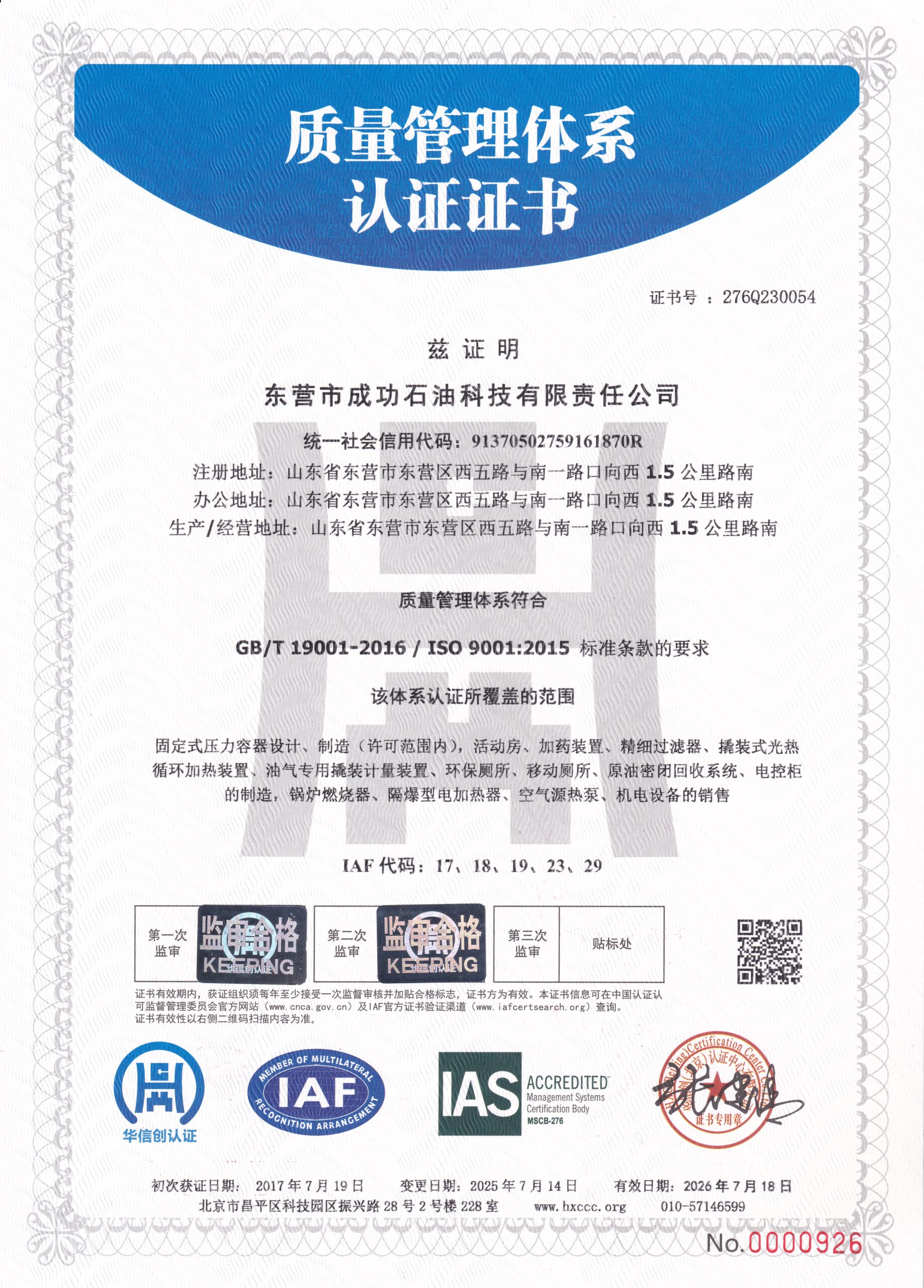
Certifications
- Special Equipment Manufacturing License -- Pressure Vessels (A2 + High-Pressure Vessel)
- GB 150 design and fabrication compliance
- ISO 9001:2015 Quality Management System
- ISO 3834 Welding Quality Management
- CNAS Accredited Laboratory
- Sinopec & CNPC HSE Certified Supplier
- ASME U-stamp -- available on request
- SGS / BV / DNV -- third-party inspection
- ISO 14001 / ISO 45001
Comprehensive QA Process

Heating Equipment -- Certified, Field-Proven, and Operating in China's Upstream Industry.

LINSON OIL Heating Equipment Track Record
Across all product lines, LINSON OIL has delivered equipment to more than 5,000 projects over 21 years. Vacuum phase-change heaters have been supplied for wellhead, gathering station, and processing facility heating applications in China and internationally.
Warranty Terms
Standard: 2 years from commissioning or 26 months from shipment -- covering vacuum shell integrity, coil integrity, burner assembly, and control system. (Industry benchmark: 1 year). The sealed vacuum heat medium circuit and absence of moving parts (no circulation pump) make this one of the most mechanically reliable heater designs in field use.
Long-term partners: up to 2.5 years, with priority spare parts access (burner components, thermocouple elements, solenoid valves, vacuum gauges) and dedicated technical contact.
After-Sales Support
- Vacuum maintenance guidance: procedure for checking and maintaining operating vacuum
- Burner commissioning and tuning support: remote or on-site
- Efficiency monitoring: flue gas analysis methodology for field verification
- Coil replacement engineering support if process conditions change
- On-site commissioning engineers available for complex installations

Higher Efficiency Starts with the Right Heater Specification.
Vacuum phase-change heater sizing requires your heating duty, process fluid, coil design pressure, and outlet temperature target. Send us these parameters and our engineers will calculate the recommended unit size, confirm the efficiency advantage at your specific operating conditions, and provide a relevant reference -- typically within 1-2 business days.
Free Engineering Resource
Submit your process parameters and receive:
- Heater duty calculation and recommended unit configuration (single-body or split-body)
- Efficiency comparison vs. conventional water bath heater at your specific operating conditions
- Relevant project reference matched to your application and heating duty range
*Reviewed by LINSON OIL process engineers. Response typically within 1-2 business days.*