MOLECULAR SIEVE DRYERS
When TEG Dehydration Is Not Deep Enough
Triethylene glycol (TEG) dehydration achieves water dew points of approximately -15°C to -30°C under favorable conditions. Molecular sieve dehydration goes further -- to -40°C, -70°C, or below -- and holds that performance reliably across the full operating cycle. For any process downstream that cannot tolerate hydrate formation, ice plugging, or freeze-out, molecular sieve is the specified technology.

LNG Feed Gas Dehydration
LNG liquefaction operates at cryogenic temperatures below -160°C. Water content in the feed gas must be reduced to below 1 ppmv -- often to 0.1 ppmv. Any water above this level will freeze and block heat exchanger passages. Molecular sieve dehydration is the mandatory upstream step before every LNG liquefaction unit.

Cryogenic NGL Recovery
Deep NGL recovery uses cryogenic heat exchangers and expansion turbines operating at temperatures below -80°C to -100°C. Water content must be below 1 ppmv to prevent catastrophic failure from hydrate formation or ice plugging. We design molecular sieve systems sized for full gas throughput at cryogenic train inlet conditions.

Pipeline Export Gas Spec
International pipelines frequently require water dew points below -10°C to -20°C at operating pressure. Molecular sieve dehydration provides a robust solution for gas streams with variable water content, high H₂S/CO₂, or when pipeline operators require guaranteed specifications with online verification.

Combined Mercury Removal
Elemental mercury amalgamates with aluminum in cryogenic plants, causing catastrophic failure. Mercury adsorbents can be loaded into the molecular sieve vessel or a dedicated guard bed downstream, providing combined dehydration and mercury removal in a single process step.
Adsorption-Regeneration Cycle
How Molecular Sieve Dehydration Works
1 The Adsorption Principle
Molecular sieves are synthetic zeolite materials with a precisely uniform pore structure measured in Angstroms (Å). Type 4A (4 Å pore diameter) is the industry standard: large enough to admit water molecules (2.8 Å) but excludes larger hydrocarbons. Water is physically adsorbed onto the crystal surface with high selectivity and capacity. The bed operates until it approaches saturation, requiring regeneration.
Three-Tower Configuration
For high gas flow rates or strict dew point consistency without switchover transients. One adsorbing, one heating, one cooling simultaneously. Provides a spare vessel for maintenance.
Online Dew Point Monitoring
Chilled mirror or Al₂O₃ sensor provides continuous verification. Feeds back to PLC to trigger early switchover on high dew point alarm. SCADA integrated for remote stations.

Engineering Specifications
System Parameters
| Parameter | Standard Range / Details |
|---|---|
| Number of Towers | 2 (standard) / 3 (high-continuity duty) |
| Inlet Gas Flow Rate | 1×10⁴ - 300×10⁴ Nm³/d (Larger with parallel trains) |
| Outlet Water Dew Point | -40°C to -70°C (at line pressure) |
| Outlet Water Content | < 1 ppmv for LNG / cryogenic duty |
| Adsorption Cycle Time | 8-12 hours standard (Adjustable in PLC) |
| Regeneration Temp | 250°C - 320°C |
| Molecular Sieve Type | 4A (std) / 3A (alcohol) / 13X (H₂S+CO₂ co-removal) |
| Vessel Design Pressure | 1.0 - 10.0 MPa (g) |
| Vessel Material | Q345R / 16MnDR / 316L SS |
| Design Code | GB 150 (vessels) / GB/T 20801 (piping) |
Adsorber Vessel Sizing (Indicative)
| Gas Flow Rate (Nm³/d) | Typical Vessel ID | Sieve Load (per tower) |
|---|---|---|
| 5×10⁴ | DN600 - DN800 | 1-3 tonnes |
| 20×10⁴ | DN1000 - DN1200 | 4-8 tonnes |
| 50×10⁴ | DN1400 - DN1600 | 10-20 tonnes |
| 100×10⁴ | DN1800 - DN2200 | 20-40 tonnes |
| 200×10⁴+ | Multiple parallel trains per detailed design | |
*Indicative figures -- actual sizing requires inlet gas composition, pressure, temperature, and dew point specification.
Standard Skid Supply & Customization
Standard Factory Skid
LINSON OIL supplies systems as fully factory pre-fabricated skid packages.
- 2 × adsorber vessels (GB 150)
- Molecular sieve loading (4A standard)
- Inlet gas knockout drum
- Regeneration gas heater (electric or fired) & cooler
- Regeneration gas knockout drum
- Pneumatic actuated high-cycle switching valves
- Skid piping, supports, and P&ID instrumentation
- PLC control panel with HMI touchscreen
- Online dew point analyzer
- Factory Acceptance Test (FAT) & Export crating
OEM / ODM Custom Options
- Three-Tower Configuration Continuous duty; no dew point transient at switchover
- Mercury / Acid Gas Co-Removal Hg guard bed or 13X sieve for simultaneous H₂S/CO₂ partial removal
- High-Pressure & Ex-Proof Vessels >10 MPa; ATEX/IECEx certified electric heaters
- Advanced Control & Monitoring SCADA/satellite telemetry; redundant dew point analyzers
- Global Compliance ASME U-stamp vessels; full process simulation & isotherm modelling
First-of-Its-Kind. Certified. Field-Proven.
Manufacturing Licenses
- • Pressure Vessels (A2 + High-Pressure)
- • Radiation Safety Permit
- • CNAS Accredited Laboratory
- • GB 150 Design & Fabrication
Innovation Recognition
2025 First-of-its-Kind Equipment: Dehydration & Demercurization Skid (CNOOC Wushi onshore terminal)
2024 First-of-its-Kind Equipment: Associated Gas Intelligent Recovery System
6-Step Quality Assurance Process
Design & Simulation
Adsorber sizing based on equilibrium data. Cycle times and heater duty calculated for full expected sieve lifetime. Client review before fabrication.
Fabrication & NDT
GB 150 compliance. CNAS-accredited RT on pressure welds, UT on joints. Hydrostatic test at 1.25× design pressure.
Internal Loading
Sieve pre-dried, screened, and verified. Bed depth, screen integrity, and support grid installation strictly documented.
Instrument Loop Test
Individual loop test for every instrument: transmitter range, valve stroke, alarm setpoints, and PLC I/O verification.
Factory Acceptance Test (FAT)
Full system simulation: valve sequencing, analyzer integration, alarm/shutdown tests. Client witness available.
Export Preparation
Vessels preserved, sieve sealed against moisture. PLC backed up. Export crating and full shipping documentation prepared.
Deep Dehydration -- Delivered
Engineered for China's most demanding upstream projects and international LNG facilities.

Shunbei No. 5 Joint Station
Deep dehydration of Ordovician reservoir gas (>7,000m depth; high pressure/H₂S). Twin-tower automatic cycling with online SCADA integration. Met extreme inlet conditions requiring robust adsorber design and acid-resistant sieve.

Onshore Terminal Dehydration & Demercurization
Combined deep gas dehydration and mercury removal guard bed. Protects downstream LNG liquefaction from water freeze-out and mercury amalgamation damage. First integrated skid of this design in Shandong Province.
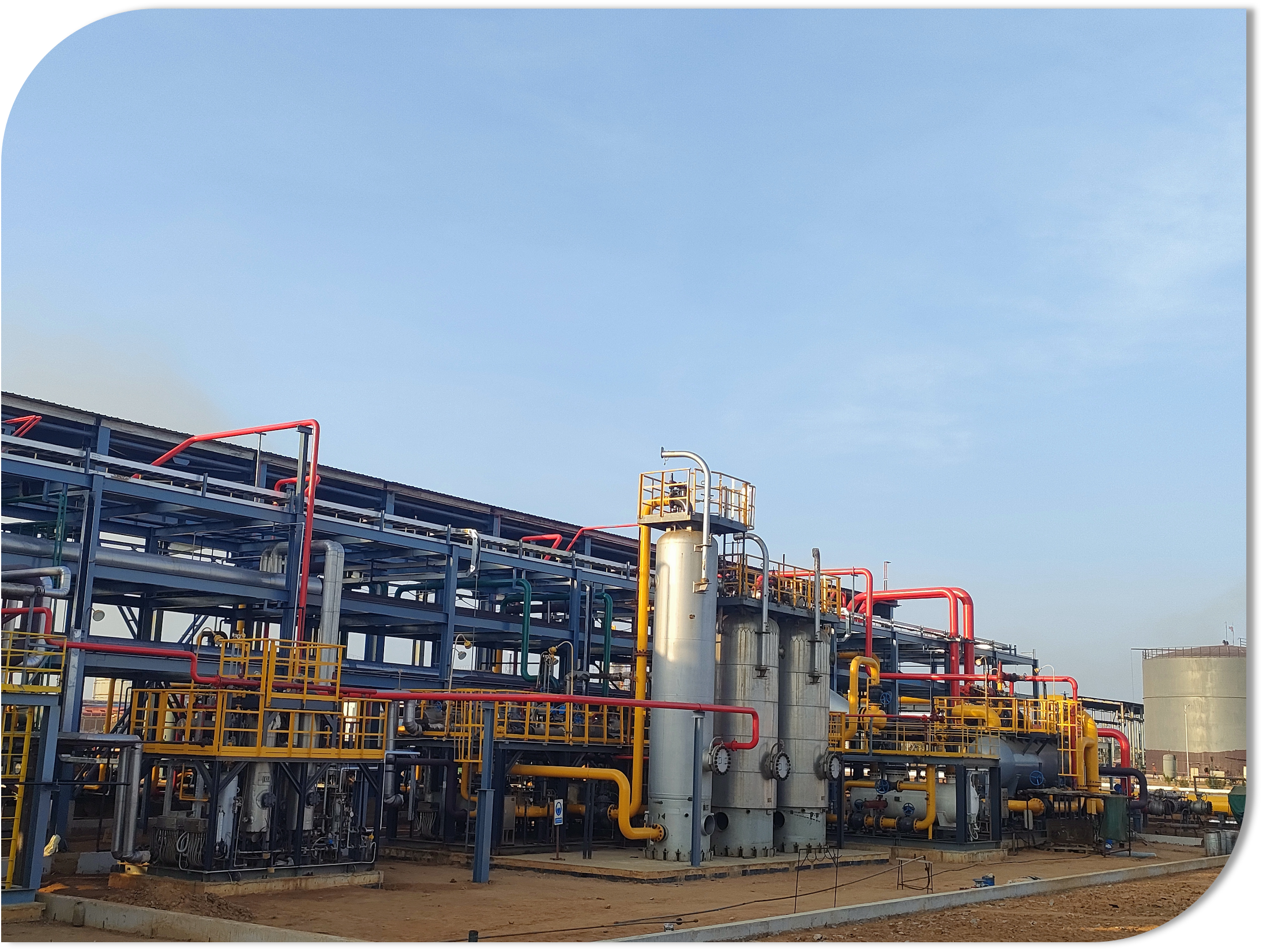
Jiarou Oilfield, Phase I/II/III
Molecular sieve dehydration incorporated upstream of LNG liquefaction cold box across all three phases. Achieved strict < 1 ppmv water content requirement for 200×10⁴ Nm³/d total gas recovery processing.
Industry-Leading Warranty
Standard: 2 years from commissioning (above 1-year industry average). Covers both mechanical vessels and PLC control systems. Long-term partners up to 2.5 years.
Molecular Sieve Lifecycle
Full support for the 3-5 year media lifespan. Includes activity testing protocols, re-loading engineering support, and capacity upgrade analysis if field conditions change.
After-Sales Support
Remote PLC access for cycle parameter adjustment. Process engineering troubleshooting for breakthrough analysis. On-site commissioning and analyzer calibration.
Tell Us Your Dew Point Target.
Submit your gas parameters and receive a preliminary system design (vessel sizing, cycle summary) with relevant project references within 24 hours.
Free Engineering Resource
Submit your gas parameters and receive:
- Preliminary sizing: tower diameter, bed height, sieve load.
- Cycle design summary: adsorption time, heater duty, gas flow rate.
- Project reference matching: Shunbei, CNOOC Wushi, or Jiarou LNG.