

ELECTROMAGNETIC
Plug-and-play wellsite heating -- electromagnetic heater units, power distribution, and control panel integrated on a single transportable skid. Connect power. Connect pipework. Heat.
When Speed of Deployment and No Open Flame Are the Priority
An electromagnetic heater skid is the answer to a specific set of field conditions: a wellsite or flowline that needs heating, has electrical power available or can be provided with a generator, is in a hazardous area where combustion equipment requires permits or is excluded, and where the production team needs heating operational within hours of skid arrival -- not days.

New Well Production Start-Up
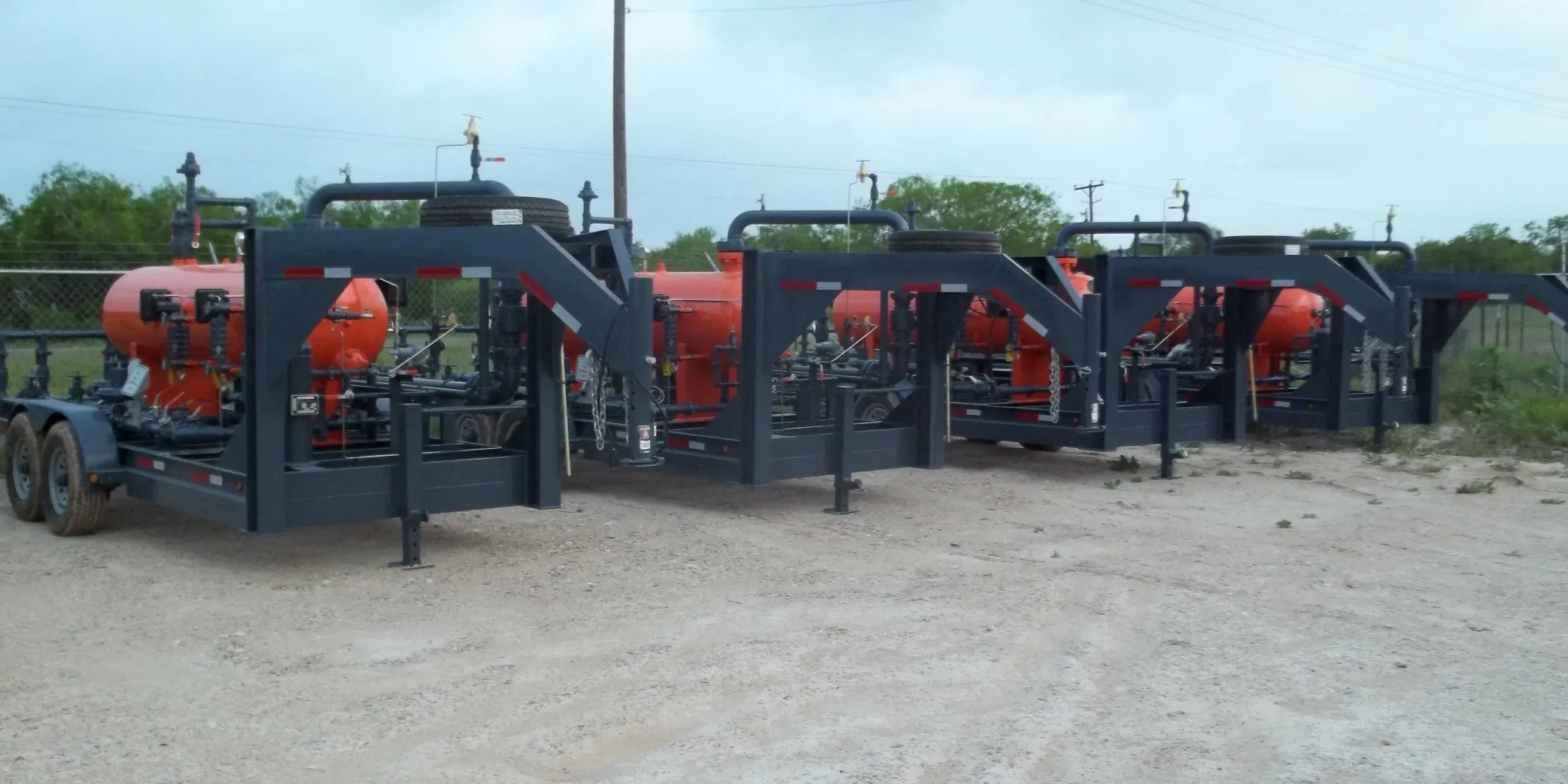
When a new well begins production, heating is frequently required from day one: to prevent wax deposition in the flowline before the well has warmed up the pipeline, or to reduce crude oil viscosity for the first tanker loading from a cold tank. An electromagnetic heater skid can be transported to the wellsite on a flatbed truck, set on a prepared pad, connected to the site electrical supply and the pipeline, and energised -- without any field fabrication or combustion infrastructure. Time-to-production is compressed from days to hours.
Production Testing & Evaluation
During production testing -- when a new well or workover completion is being evaluated -- temporary heating is often needed to condition the produced fluid for test separator measurement. A skid deployed for the duration of the test avoids the cost of installing permanent heating infrastructure that won't be needed later. At the end of the test programme, the plug-and-play design makes the skid as easy to remove as it was to install.

Hazardous Area Heating
Oilfield processing areas classified as Zone 1 or Zone 2 exclude conventional fired heaters. Electric resistance heaters require careful surface temperature management and have high failure rates in crude oil service. Our skid -- certified to ExdbIICT3/T4/T5/T6Gb -- is rated for Zone 1 installation with IIC gas group coverage. The absence of combustion and the inherent surface temperature limitation of the induction principle make it the preferred heating technology.

Remote Wellsites (Generator Power)
Remote wellsites without grid connection can still use electromagnetic heating if a generator is available -- common for wellsites with electric submersible pumps (ESP). The heater skid connects to the site generator. Where a generator upgrade is required, LINSON OIL provides the heater power consumption specification at the quotation stage, allowing generator sizing to be confirmed before procurement.
Heater Units vs. Heater Skid -- What the Skid Adds
The Gap Between "Equipment" and "Working System"
Purchasing electromagnetic heater units and installing them in the field requires: a structural mounting arrangement, an electrical power distribution panel, explosion-proof cable from the panel to each heater unit, an earthing and bonding system, temperature controller wiring and sensor installation, and all of this designed and executed to the hazardous area classification of the installation. For a single-use or temporary application, this field engineering scope adds cost and time that often exceeds the heater unit cost itself.
An electromagnetic heater skid integrates all of this in the factory, under a quality system, tested before shipment, so that the field scope is reduced to: set the skid on a pad, connect the power supply cable, connect the pipeline flanges, and energise. The site electrician's work is measured in hours. The process engineer's commissioning work is setting the temperature setpoint on the HMI.

What Is Integrated on the Skid
Engineering Specifications
| Parameter | Standard Range | Notes |
|---|---|---|
| Heating Duty per Skid | 20 kW - 1,000 kW | Multiple heater units on one skid; multiple skids for higher duty |
| Heater Unit Type | Pipeline (clamp-on) / Immersion (tank) | Per application |
| Number of Heater Units | 1 - 8 per skid | Per duty and skid transport envelope |
| Thermal Efficiency | ≥ 98% | Measured in factory efficiency test |
| Explosion Protection | ExdbIICT3/T4/T5/T6Gb | Zone 1 and Zone 2 installation |
| Power Supply | 380V / 50Hz (standard) | 415V / 460V / other on request |
| Power Panel Enclosure | ExdIIC -- flameproof | Zone 1 rated |
| Temperature Control | PID controller per heater unit; HMI | High-temperature shutdown and alarm |
| Control Range | 0°C - 200°C (T3); 0°C - 135°C (T4) | T-class determines max surface temp |
| Communication | 4-20 mA output / Modbus RTU (opt) | For SCADA integration |
| Pipeline Size | DN50 - DN600 | Matched to client pipeline |
| Pipeline Connection | Flanged (ANSI 150# - 600#) | Higher ratings on request |
| Skid Frame | Carbon steel; epoxy coat | Galvanised option for marine |
| Transport Dimensions | Standard road transport envelope | Larger configurations as two modules |
| FAT | Power-on, temp control, Ex inspection | Client witness available |
Standard Skid Package & Customization Options
Standard Package (Included)

- Structural skid frame (carbon steel; primer + high-build epoxy topcoat; lifting pads)
- Electromagnetic heater units (quantity and type per heating duty calculation)
- Per-heater: inductor assembly, ExdIIC housing, surface thermocouple sensor
- ExdIIC power distribution panel: incoming terminals, per-heater breaker, isolation switch, RCD/GFCI
- Per-heater PID temperature controller with HMI on panel door
- High-temperature shutdown and alarm (automatic de-energise + manual reset)
- Explosion-proof cable routing between panel and each heater unit
- Skid earth bonding system with site earth connection terminal
- Pipeline connection flanges per heater unit (blanked for transport)
- Factory efficiency test (electrical input vs. temperature rise measurement)
- FAT: power-on, temperature control, shutdown function, Ex inspection, loop check
- Quality dossier & As-built electrical drawings
OEM / ODM Customization Options
ExdbIICT3/T4/T5/T6Gb Certified. ≥98% Efficiency Measured. Factory Tested as a Complete System.

Quality Assurance Process
Step 1 -- Heating Duty Calculation
Required heating duty calculated from fluid type, flow rate, inlet/outlet temps, and heat loss. Heater unit count and rated power confirmed before procurement. Duty calculation documented and submitted for client review.
Step 2 -- Ex Component Verification
All explosion-proof components verified against their Ex certificates: certificate number, T-class, gas group, and IP rating recorded in the quality file. No substitution of Ex-certified components with non-certified alternatives.
Step 3 -- Electrical Installation Inspection
Completed skid wiring inspected per IEC 60079-17: cable bending radii, conduit sealing, gland installation, earthing continuity, and enclosure integrity. Inspection checklist maintained as part of quality dossier.
Step 4 -- Insulation and Continuity Test
500V DC megger test for insulation resistance. Ground continuity test from each heater unit casing to skid earth terminal. High-voltage withstand test on power panel wiring.
Step 5 -- Thermal Efficiency Factory Test
Each heater unit powered at rated load. Electrical input measured by calibrated power analyser. Thermal efficiency confirmed ≥98% per unit. Test record included in quality dossier.
Step 6 -- Control System and Shutdown FAT
High-temperature shutdown triggered by simulated thermocouple signal above setpoint: confirmed heater de-energises and alarm activates; manual reset confirmed. SCADA output signals verified.
Step 7 -- Ex Inspection and Export Preparation
Final Ex inspection per IEC 60079-17. Pipeline flanges blanked. Export crating applied. Full documentation package assembled including operation manual and FAT report.
Plug-and-Play Electromagnetic Heating -- Deployed Across Upstream Operations.
Multiple Upstream Facilities
Electromagnetic heater skids providing plug-and-play heating for wellhead flowlines, crude oil transfer lines, and wellsite storage tanks have been supplied to upstream production facilities where rapid deployment without combustion infrastructure was the primary requirement.
Sinopec & CNPC HSE Certified
Equipment supplied to Sinopec and CNPC is subject to rigorous HSE qualification -- including Ex certificate validity verification, hazardous area compliance, and installation inspection. LINSON OIL is a certified supplier in both NOC systems.
87 Technology Patents
Backed by 87 patents including invention patents covering inductor design geometry and explosion-proof enclosure configurations, ensuring Zone 1 compliant installation without field engineering.
View Full Technical DetailsWarranty Terms
Standard warranty from commissioning (or 26 months from shipment).
Industry benchmark is 1 year. Our skids have no combustion components and no elements in fluid contact, eliminating conventional failure modes. Long-term partners receive up to 2.5 years warranty.
After-Sales Support
-
IEC 60079-17 Inspection Support Checklist provided for annual Ex equipment visual and detailed inspections required by standard.
-
Parameter Adjustment Remote support for setpoint changes, PID tuning, and alarm setpoint review.
-
Redeployment Engineering Advisory and replacement inductors if redeploying to a different pipeline diameter.
-
Power Supply Change Review and advise on panel modifications if site voltage or frequency changes from original design.
Pipeline Size, Heating Duty, Power Supply, Area Classification.
Electromagnetic heater skid specification starts with four parameters. Send us these parameters and our electrical and process engineers will specify the heater unit count, skid configuration, and Ex rating -- typically within 1-2 business days.
Free Engineering Resource
Submit your heating requirement and receive:
- Preliminary skid specification (heater unit count, rated power per unit, skid dimensions and weight)
- Power supply requirement (total connected load, recommended circuit protection sizing)
- Ex rating confirmation (T-class recommendation for your site gas group)
