
CONDENSATE STABILIZATION COLUMNS
Turn unstabilized condensate into a saleable, storage-safe liquid product -- rectification and stripping column systems engineered to your RVP specification.
The Problem: Unstabilized Condensate Cannot Be Safely Stored or Transported
Condensate leaving a three-phase separator or wellhead separation train is saturated with dissolved light hydrocarbons -- methane, ethane, propane, and butane. At storage tank or transport conditions, these components flash to vapor, creating overpressure in storage tanks, excessive vapor losses, and a significant safety hazard. A condensate stabilization column is the engineering solution that removes these light components and delivers a stable, specification-grade liquid product.

Field Condensate Stabilization for Road Transport
Condensate produced at remote wellsites or gathering stations must be transported to market by road tanker before pipeline infrastructure is available. Road tanker loading specifications -- typically a Reid Vapor Pressure (RVP) of 10-14 psi (69-97 kPa) -- cannot be met by separator-train condensate alone. A stabilization column at the gathering station removes the light ends and delivers condensate that can be safely loaded into road tankers without excess vapor generation or pressure relief activation during transport.

Condensate Stabilization Upstream of Pipeline Injection
Condensate injection into crude oil export pipelines requires the condensate to meet pipeline entry specifications for vapor pressure and light component content. Unstabilized condensate with dissolved gas can create two-phase flow in the pipeline, disrupt metering accuracy, and cause slug flow in downstream receiving facilities. Stabilized condensate at the specified RVP is a prerequisite for clean, single-phase pipeline injection.

NGL Plant Feed Stabilization
In NGL recovery operations, the liquid product from the demethanizer or de-ethanizer may require final stabilization to remove remaining light components before the NGL stream is split into propane, butane, and stabilized light hydrocarbon products. A condensate stabilizer at this stage ensures the bottom NGL product meets vapor pressure and composition specifications for downstream fractionation or product sale.

Metering Station Condensate Processing
Condensate collected at metering stations from individual well or wellpad production streams is frequently unstabilized. Processing this condensate through a stabilization column recovers the light components as a saleable gas stream while producing a stabilized condensate for storage or pipeline. The Sinopec Longfengshan project delivered by LINSON OIL addressed exactly this scenario.
Condensate Stabilization Process: Rectification, Stripping, and Product Recovery
The Two Stabilization Routes
Condensate stabilization can be achieved by two process routes, each with different capital cost, energy consumption, and product recovery characteristics:
Route 1 -- Cold Feed Stabilization (Simple Flash Cascade)
Unstabilized condensate is fed through a series of flash stages at progressively lower pressures and/or elevated temperatures. Each flash removes light components as vapor. The final liquid is the stabilized condensate. This approach has lower capital cost and no reboiler energy requirement but achieves lower light component separation efficiency and cannot achieve as low an RVP as a distillation-based stabilizer for a given heat input. Suitable for applications with moderate RVP requirements and limited energy availability.
Route 2 -- Distillation-Based Stabilization (Rectification + Stripping)
This is the higher-performance route and the design basis for LINSON OIL's condensate stabilization columns. Unstabilized condensate is fed to the mid-section of a distillation column. The column has two functional zones:
-
Stripping Section (below feed point): A reboiler at the column base provides heat to generate an ascending vapor stream within the column. This vapor strips light components (methane, ethane, propane) from the descending liquid. The efficiency of stripping determines the RVP of the stabilized condensate at the column bottom.
-
Rectifying Section (above feed point): The ascending vapor contacts descending reflux liquid from the overhead condenser. The rectifying section enriches the overhead vapor in light components while recovering heavier components (propane, butane) back into the liquid phase -- preventing valuable C3+ products from being lost overhead.
Overhead System: Overhead vapor from the column top is partially condensed in an air or water cooler. The condensed liquid (propane-butane-rich) is returned to the column as reflux. The non-condensed gas is collected in a reflux drum and routed as fuel gas, reinjection gas, or to a downstream LPG recovery system.
Reboiler: The reboiler provides the energy driving the separation. Options include Thermosiphon (steam/hot oil), Fired (direct-fired heater), or Electric reboilers.
Feed Preheating: In energy-optimized designs, the cold feed condensate is preheated by heat exchange with the hot stabilized condensate product stream, reducing reboiler duty.
Key Design Output: RVP Achievement
The stabilized condensate Reid Vapor Pressure (RVP) is the primary performance specification. Typical targets:
- Road tanker: 10-14 psi (69-97 kPa)
- Pipeline injection: 6-10 psi (41-69 kPa)
LINSON OIL designs stabilization columns to the client's specific RVP target, with a process guarantee basis agreed during the engineering phase.
Engineering Specifications
| Parameter | Standard Range | Notes |
|---|---|---|
| Column Type | Packed (structured or random) / Tray (sieve or valve) | Selected per throughput, fouling tendency, and pressure drop |
| Column Diameter | DN400 - DN2500+ | Per liquid throughput and vapor loading |
| Column Height (T/T) | 8 m - 35 m | Per number of theoretical stages required |
| Design Pressure | Vacuum - 4.0 MPa (g) | Top: sub-atmospheric possible; bottom: reboiler temp-dependent |
| Design Temperature | -20°C to +300°C | Bottom limited by reboiler temperature |
| Shell Material | Q345R / 16MnDR / 316L SS | Per fluid composition; H₂S dictates upgrade |
| Number of Theoretical Stages | 8-25 typical | Per feed composition and RVP specification |
| Reboiler Type | Thermosiphon / Fired / Electric | Per available utilities and unit size |
| RVP Target Range | 6-14 psi (41-97 kPa) | Lower RVP achievable with increased reboiler duty |
| Process Guarantee | RVP at design feed composition | Agreed during engineering phase |
Stabilization Route Selection Guide
| Factor | Cold Feed Flash | Distillation (Rectification + Stripping) |
|---|---|---|
| Capital cost | Lower | Higher |
| RVP achievability | Moderate (≥12 psi typically) | Full range (6-14 psi) |
| C3+ recovery | Lower | Higher (reflux recovers C3+) |
| Energy requirement | Lower | Higher (reboiler duty) |
| Best for | Remote, small-scale, limited utilities | Larger scale, tight RVP spec, C3+ value recovery |
Standard Supply & Full Customization Scope
LINSON OIL supplies condensate stabilization systems as engineered packages, with flexible OEM/ODM capabilities.
Standard System Supply
1. Process Design
- Feed composition and flow rate basis review
- Process simulation (rigorous distillation calculation)
- Column sizing & reboiler duty calculation
- Heat integration & RVP guarantee basis documentation
2. Mechanical Supply
- Stabilization column (shell, internals, nozzles)
- Reboiler & Overhead condenser
- Reflux drum & Feed preheater
- Interconnecting piping, instrumentation, and steel structure
OEM / ODM Customization
- Fired reboiler design Remote location; no steam utility
- LPG recovery overhead Propane/butane recovery as liquid LPG
- H₂S / sour service upgrade PWHT; NACE MR0175 materials
- High-efficiency structured packing Low pressure drop; max stage efficiency
- Complete skid integration With PLC control & FAT
- ASME U-stamp International export compliance
Process Design In-House. Fabrication Certified. Performance Guaranteed.
For LINSON OIL, it is an engineered system, not just a fabricated vessel. This end-to-end ownership reduces the risk that sits in the gap between process design and mechanical fabrication.
Condensate Stabilization -- Delivered to Upstream and Midstream Operators.

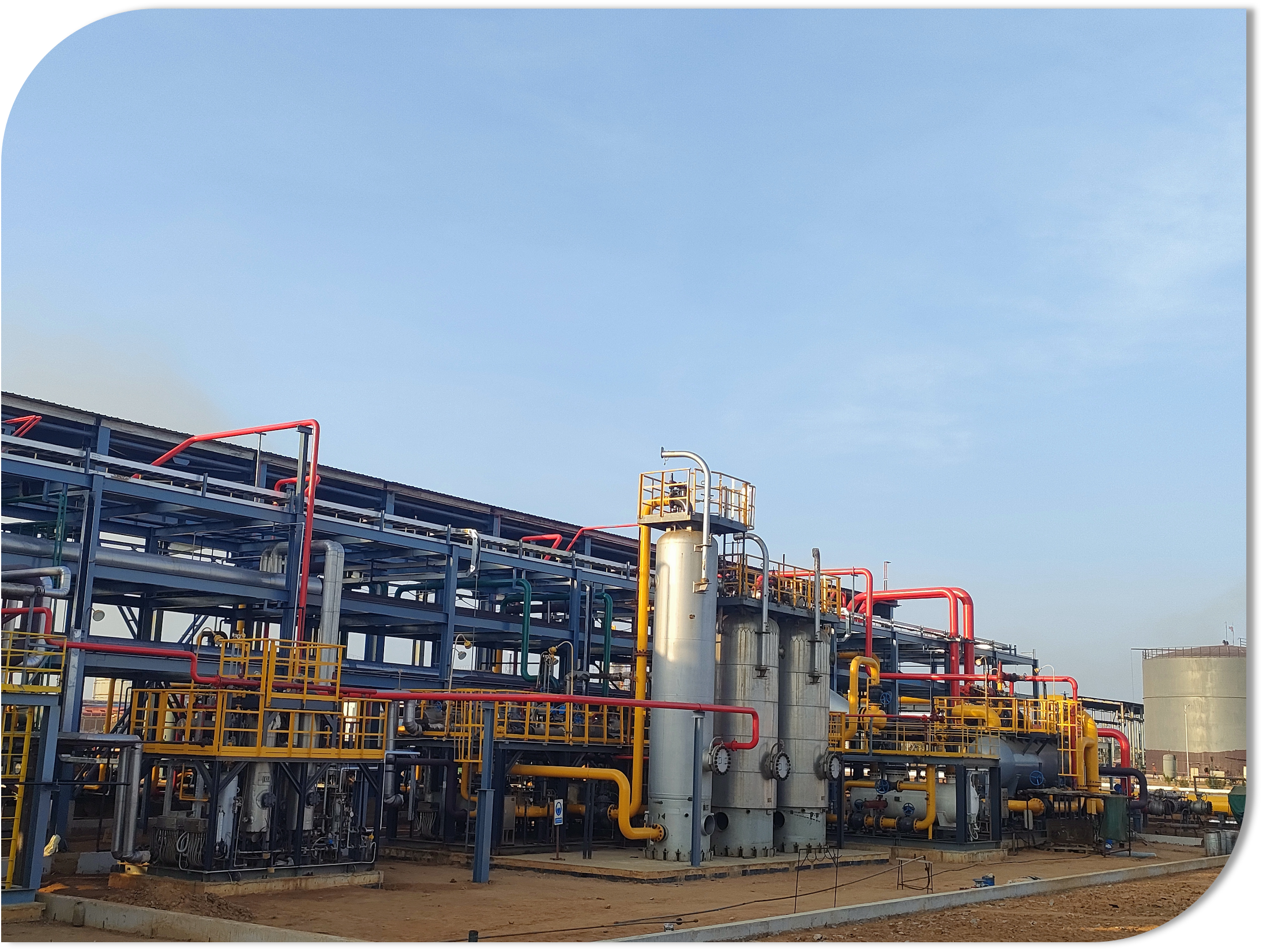
Longfengshan Condensate Stabilization Unit
Processing unstabilized condensate from metering and production separators across the field. Light component removal to meet stabilized condensate RVP spec for storage and transport.

Onshore Terminal (2025 First-of-its-Kind)
Condensate stabilization as part of an integrated crude dehydration, stabilization, and LNG liquefaction system handling offshore production.
 ng="async">
Jiarou Oilfield Phase I/II/III
NGL stabilization and product fractionation integrated into the associated gas recovery and LNG liquefaction system.
Industry-Leading Warranty
Long-term partners up to 2.5 years.
LINSON OIL's extended warranty reflects our ownership of both the process design and the mechanical fabrication -- we stand behind the whole system, not just the steel.
After-Sales Engineering Support
- Remote consultation on RVP deviations & reboiler duty optimization
- Revamp studies for capacity expansion or spec changes
- Commissioning support: start-up, reflux establishment, RVP verification
RVP Spec. Feed Composition. We'll Design the Column to Hit Both.
Condensate stabilization is a process engineering problem before it is a fabrication project. Send us your feed condensate composition and your product RVP target, and our engineers will respond with a process design basis within 24 hours.
Free Engineering Resource
Submit your data and receive: Stabilization route recommendation, Preliminary column sizing (diameter, stages, reboiler duty), and Relevant project references. Reviewed by LINSON OIL process engineers.